
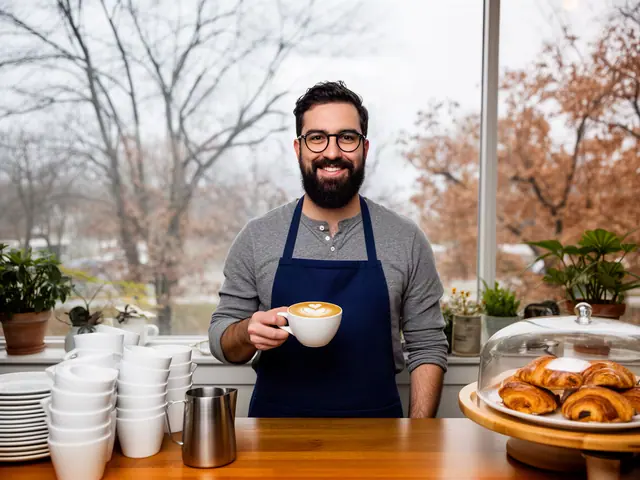
Fieldhaven Business Funding in Valparaiso, Indiana covers cafe business loans for Porter County, Indiana coffee shops: espresso machine loans, grinders and brewers, counter build-outs, loans to buy an existing cafe, and how card-sales advances compare. The county had 38 snack and nonalcoholic beverage bar employers with 575 employees in 2023.
At a glance
- Snack and beverage bar employers, Porter County, IN
38 (County Business Patterns 2023)
- Snack and beverage bar employees
575 (County Business Patterns 2023)
- Fewer than five employees
28.9% (County Business Patterns 2023)
Coffee Shop Loans in Porter County, IN: What the Census Code Covers
County Business Patterns files coffee shops under snack and nonalcoholic beverage bars, a code that also holds juice bars, ice cream and frozen dessert shops and doughnut shops. In Porter County, IN that code counted 38 employer establishments in 2023, with 575 employees and $10.4 million in annual payroll, about $18,003 per employee (our arithmetic); 28.9% had fewer than five employees (County Business Patterns 2023). Within ZIP 46383 the same code counted 19 (ZIP Code Business Patterns 2023).
Counter staff, opening hours that start before sunrise and a high share of card payments shape how a coffee shop's request is read.
Espresso Machine Loan for a Two- or Three-Group Machine
The espresso machine is the counter's most expensive item, and it carries a resale market. Illustration only, invented figures: a three-group espresso machine at an invented $18,500, two grinders at $3,200 and a batch brewer at $2,400 total $24,100; over 48 months at an invented 10.5%, the payment is about $617 a month (our arithmetic). Equipment financing secured by the machines fits this purchase.
Roaster programs sometimes place a machine in a shop in exchange for buying their beans. That is a supply contract, not financing, and its total cost is buried in the bean price; set it beside an equipment loan in dollars over the same period.
Cafe Equipment Finance Beyond the Espresso Bar
- Refrigerated display cases and under-counter fridges.
- Ovens for pastries and breakfast items.
- Ice machines and blenders for cold drinks.
- Water filtration that protects the espresso machine.
- A point-of-sale system with an online ordering tablet.
Small items with short lives, such as pitchers, scales and tampers, sit better on the shop's own money or a revolving line than on an equipment loan.
Coffee Shop Financing for a Counter Build-Out
A new location needs plumbing for the espresso machine and sinks, electrical for high-draw equipment, a counter, seating and signage. Illustration only, invented figures: an invented $64,000 build-out bid splits into equipment that can secure its own loan and construction that cannot. The construction part suits a term loan; a partner can ask for the lease, the landlord's approval and the bid split into the two parts.
Loan to Buy a Cafe That Is Already Open
Buying a running cafe brings the equipment, the lease, the staff and the regular customers. Illustration only, invented figures: an invented $155,000 price with $31,000 down, financed over 84 months at an invented 10%, costs about $2,059 a month (our arithmetic). A partner reads the seller's tax returns, daily sales reports and the lease's remaining term, because a cafe without its location loses most of what the buyer is paying for.
Business loan to buy a cafe: the steps match those for any acquisition, and the lease transfer is the step to settle first.
Daily Sales, Card Receipts and a Cash Advance Offer
Illustration only, invented figures: a cafe selling an invented 260 drinks a day at an average of $6.25 takes in about $1,625 a day (our arithmetic), much of it by card. That steady card flow is why cafes receive merchant cash advance offers, where a provider buys part of future card receipts and collects them as sales settle. An advance is not a loan; the merchant cash advance page sets its cost in dollars beside a loan.
Working Capital for a Coffee Counter's Slower Weeks
Rent, payroll and milk and bean orders do not shrink when foot traffic does. A working capital loan covers a single gap, such as wages while a new location builds its customer base; a revolving line covers a gap that returns. A partner reads weekly sales and cost of goods to see how much of each sale is left over.
A Second Counter, a Drive-Up Window or a Roasting Room
Growth for a coffee business can mean a second counter, a drive-up window added to an existing site, or a small roaster that supplies the shop and wholesale accounts. Each brings a different mix: a second counter repeats the first build-out, a drive-up window is mostly construction and permits, and a roaster is equipment with its own resale market plus green coffee stock. A partner reads the first location's results as the case for the next.
Register Reports and the Roaster Contract in a Cafe's File
- Business bank statements and card processing statements.
- Point-of-sale reports by day and by item.
- The lease and any roaster or supplier contracts.
- Equipment quotes, or serial numbers for used machines.
- Existing loans, leases and advances.
The restaurant page covers full kitchens, and the Valparaiso, IN page has county and ZIP counts.
By Fieldhaven Business Funding · Updated